
There are exceptions to copyright allowing use of works without specific permission in most copyright regimes, and there can be confusion over the UK’s Fair Dealing exception and the USA’s Fair Use.
The British Copyright Council (AOI is a member) has produced a policy note to help politicians and policy makers understand the differences as Fair Use is being used as a defence for the scraping of creative works to be used for training generative AI. It is also useful for all those wanting to understand the differences.
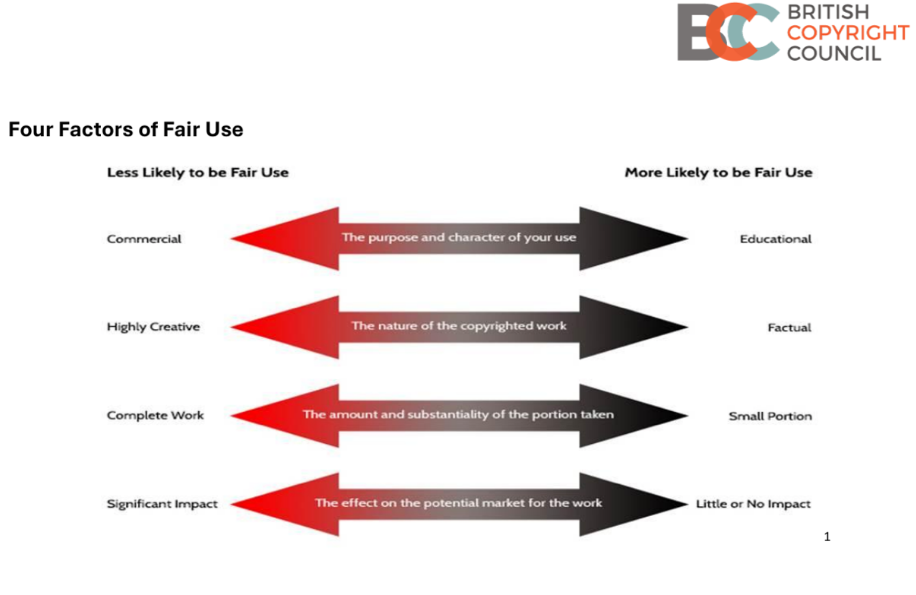
Fair Use is a flexible four-factor test, unique to the US, emphasises the BCC. Generally, Fair Use allows for the same type of activities the UK explicitly permits, such as criticism, comment, news reporting, and certain educational reuses. However, Fair Use may also be raised as a defence for novel or transformative uses. Whether or not Fair Use applies depends on analysing the specific facts and context of the copying, making judicial decisions on Fair Use inherently narrow in scope. As the US Supreme Court has noted, “The same copying may be fair when used for one purpose but not another.”
The British Copyright Council policy note outlines how Fair Use operates in the United States and explains why importing such a model into UK law would weaken the UK’s gold standard copyright framework. Far from offering greater legal certainty, a Fair Use-style approach would introduce ambiguity and fail to provide any clearer justification for the copying acts involved in machine learning.
The BCC have a useful diagram to help understand the differences:
Key Takeaways from BCC policy note
• Fair Use is not a general excuse for all copyright done during AI development. Its application depends on case-specific facts and remains legally uncertain.
• No existing copyright exception or defence covers all copying carried out during an AI system’s lifetime in all territories where such copying may occur and any Fair Use decision is limited to actions that take place in the United States.
• Any copyright exception is specific to copyright infringement: Independent rights relevant to infringement of privacy, data protection, personality, trademark or other rights will remain.
• Effective licensing of copyright use presents the only approach to allow for global development of AI systems. The sooner a dynamic licensing market develops, the sooner the AI sector can thrive safe in the knowledge they are not carrying out illegal copyright acts.
• We (BCC) predict an increase in licensing in a competitive fair market.